Yoga doesn’t have to mean complicated poses, perfect flexibility, or an hour on the mat.
Sometimes all you need is two sturdy chairs and someone you enjoy spending time with.
Chair yoga for couples offers a simple way to move together without requiring either partner to be an experienced yogi. You can stretch, breathe, work on mobility, and enjoy a little shared time without getting down onto the floor for every exercise.
And no—you don’t have to move exactly the same way.
One partner might be more flexible. The other might have better balance. That’s completely fine.
The goal isn’t to see who can stretch farther.
It’s to create a comfortable practice you can enjoy together.
What Is Partner Chair Yoga?
Partner chair yoga combines traditional chair-based yoga movements with elements of partner practice.
Sometimes you’ll face each other.
Sometimes you’ll sit side by side or back to back.
And for some poses, you’ll simply perform the same movement at the same time.
The partner element can add:
- shared motivation
- communication
- optional balance support
- synchronized breathing
- a social element to your practice
You don’t need to turn every exercise into a partner-assisted stretch.
In fact, your partner generally shouldn’t push or pull you deeper into a pose.
Let each person control their own range of motion.
What You’ll Need
Keep the setup simple.
You’ll need:
- two sturdy chairs
- comfortable clothing
- enough room to extend your arms and legs
- a stable, level floor
A yoga mat underneath the chairs may provide additional grip depending on your flooring.
Water can also be kept nearby.
Choosing the Right Chairs
This part matters.
Use chairs that:
- don’t have wheels
- don’t rock or swivel
- have stable legs
- can support your weight comfortably
- don’t slide easily across the floor
Dining chairs often work well.
Avoid unstable folding chairs unless they’re specifically designed to lock securely into position.
Partner Chair Yoga Safety
Before getting into the poses, agree on one rule:
Either person can stop a movement at any time.
Don’t use your partner’s body to force yourself deeper into a stretch.
Likewise, don’t push, pull, or twist your partner because you think they could “go a little farther.”
Instead:
- communicate
- move slowly
- breathe normally
- stay within a comfortable range
- use the chair for support
- skip anything that causes pain
If either person has an injury, significant mobility limitation, balance problem, recent surgery, or another medical concern affecting exercise, individual professional guidance may be appropriate before beginning.
Start With a 3-Minute Warm-Up
Before trying the partner poses, spend a few minutes moving individually.
Sit comfortably toward the front or middle of your chairs.
Shoulder Rolls
Roll your shoulders slowly backward several times.
Reverse direction.
Don’t rush.
Gentle Neck Movement
Look slowly to your right.
Return to center.
Look left.
You can also gently tilt one ear toward the same-side shoulder.
Avoid making large, fast neck circles.
Seated Cat-Cow
Place your hands on your thighs.
As you inhale, gently move your chest forward and allow your spine to extend.
As you exhale, round your back comfortably.
Repeat 5–8 times.
Ankle Circles
Lift one foot slightly from the floor and make several controlled ankle circles.
Change direction and then switch feet.
Now you’re ready to practice together.
12 Chair Yoga Poses for Couples
1. Back-to-Back Breathing
This is one of the simplest ways to begin.
Position your chairs so you’re sitting back to back.
Sit comfortably and close your eyes if you’d like.
Rather than deliberately forcing your breathing into exactly the same rhythm, simply notice:
- your own breathing
- your partner’s movement behind you
- the contact between your backs
- the feeling of sitting upright
Stay for approximately one minute.
It’s an easy transition from conversation and activity into your shared practice.
2. Mirrored Seated Side Stretch
Move the chairs so you’re sitting side by side with enough room to extend your arms.
Both partners reach their outside arms overhead.
Gently lean toward one another.
Keep both sitting bones connected to the chair.
Take 3–5 comfortable breaths.
Return upright and change sides.
You don’t need to hold hands. If you do, keep the contact light rather than pulling against each other.
3. Mirrored Seated Cat-Cow
Now face each other.
Place your hands on your thighs.
Inhale and gently lift your chest.
Exhale and round your spine.
Move slowly and try to follow approximately the same rhythm.
The point isn’t perfect synchronization.
It’s simply a fun way to practice a familiar movement together.
4. Partner Seated Twist
Sit side by side.
Lengthen your spine and rotate gently toward your partner.
Keep your hips facing forward.
You can rest your hands on your own thighs or chair rather than using your partner to pull yourself farther into the twist.
Stay for 3–5 breaths.
Return to center and rotate in the opposite direction.
YogaMelt’s guide to Seated Spinal Twist provides more guidance on controlled twisting technique.
5. Seated Eagle Arms
Face each other.
Extend your arms forward and cross one arm underneath the other.
Bend your elbows and bring either the backs of your hands or palms toward one another.
Lift your elbows only as far as feels comfortable.
Hold for several breaths.
Release and reverse the arm crossing.
If wrapping the arms fully isn’t comfortable, simply place your hands on opposite shoulders.
YogaMelt’s Eagle Arms Yoga Pose guide offers additional modifications.
6. Mirrored Chair Warrior II
Sit slightly sideways on your chairs so you have room to position your legs comfortably.
Extend one leg outward while keeping the other knee bent.
Open your arms horizontally.
Turn your head gently toward the hand extending over the bent leg.
Your partner mirrors the position.
Hold for several breaths and switch sides.
Don’t worry about recreating the exact shape of a standing Warrior II.
The chair-supported version should suit your mobility.
7. Seated Knee Extension
Face each other.
Sit tall with both feet initially on the floor.
Slowly straighten your right knee, lifting your right foot.
Pause briefly.
Lower it.
Your partner does the same.
Repeat approximately 5–8 times before switching legs.
You can alternate or try moving together.
This isn’t really about stretching—it’s a simple controlled movement for the legs.
8. Seated Heel and Toe Raises
Remain seated facing each other.
Keep both feet on the floor.
Lift your heels while keeping your toes down.
Lower them.
Then lift your toes while keeping your heels down.
Repeat slowly.
You can turn it into a synchronization challenge, but don’t worry if one person loses the rhythm.
9. Seated Figure Four
Sit facing each other.
Place your right ankle across your left thigh if that position is comfortable for your knee and hip.
Keep your spine tall.
If you want more sensation, hinge forward slightly from your hips.
Don’t press down on your knee.
Your partner performs the same movement at their own depth.
Stay for approximately 20–30 seconds and change sides.
This is a good example of partner yoga where you practice together without physically manipulating each other’s bodies.
10. Partner Hand Press
Sit facing each other close enough to bring your palms together.
Keep your elbows comfortably bent.
Press gently into each other’s hands for several seconds.
Relax.
Repeat 3–5 times.
The pressure should be light and equal.
If one person suddenly stops pressing, the other shouldn’t fall forward.
Think connection, not competition.
11. Seated Forward Fold
Position your chairs side by side.
Place your feet comfortably on the floor.
Hinge forward gradually from your hips and allow your hands to move toward your legs or the floor.
Your partner does the same beside you.
There’s no need to hold hands or pull against one another.
Let gravity and your own range of motion determine the stretch.
Stay for several comfortable breaths before slowly returning upright.
12. Back-to-Back Relaxation
Finish where you started.
Sit back to back again.
Let your hands rest comfortably on your thighs.
Close your eyes if you’d like.
Allow your breathing to return to normal.
Stay for one or two minutes without trying to accomplish anything.
You don’t even need to synchronize your breath.
Just sit together.
A 15-Minute Chair Yoga Routine for Couples
Don’t want to remember all 12 exercises?
Try this simple sequence.
Warm-up – 3 minutes
Shoulder rolls, gentle neck movements and Seated Cat-Cow.
Back-to-Back Breathing – 1 minute
Settle into the practice.
Seated Side Stretch – 1 minute
Practice both sides.
Seated Cat-Cow – 1 minute
Move together.
Seated Twist – 2 minutes
Give each side time.
Chair Warrior II – 2 minutes
Practice both sides.
Seated Figure Four – 2 minutes
Switch halfway.
Eagle Arms – 1 minute
Practice both arm positions.
Back-to-Back Relaxation – 2 minutes
Finish quietly.
That’s a complete shared practice in approximately 15 minutes.
Chair Yoga for Couples With Different Flexibility Levels
This is where chair yoga can work particularly well.
You don’t need matching flexibility.
Imagine one partner can comfortably place an ankle across the opposite thigh in Figure Four while the other finds that position too intense.
The second person can keep the foot lower or skip the pose.
Both are still practicing together.
The same principle applies throughout the routine.
Synchronize the intention, not necessarily the range of motion.
Can Older Couples Practice Partner Chair Yoga?
Chair-based yoga can be more accessible than practices that repeatedly require getting up and down from the floor.
However, “chair yoga” doesn’t automatically mean every exercise is appropriate for every older adult.
Mobility, balance, joint health, cardiovascular conditions, medications and previous injuries vary substantially from person to person.
Keep the movements controlled and adapt them individually.
Most importantly, don’t introduce partner-assisted pulling or balance challenges simply because there are two people present.
Chair Yoga for Date Night
Not every yoga session has to be serious.
Partner chair yoga can make a surprisingly good at-home activity.
Try:
- clearing 20 minutes
- putting your phones away
- choosing some music
- doing the 15-minute routine
- finishing with a few minutes talking or relaxing together
It costs almost nothing and gives you something more interactive to do than watching another episode of a show.
And yes, laughing when your synchronization completely falls apart is allowed.
Chair Yoga vs. Traditional Couples Yoga
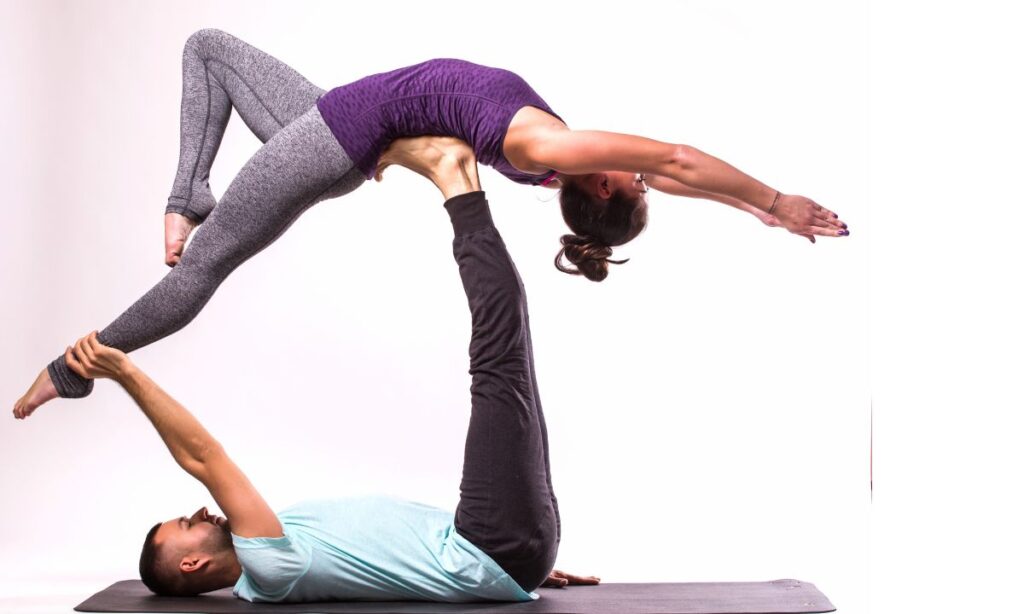
Traditional partner yoga can include standing balance poses, counterbalances, shared stretches and sometimes more advanced acrobatic movements.
Chair yoga keeps things closer to the ground and provides a stable support.
That can make it a better entry point if:
- you’re new to yoga
- getting down onto the floor is uncomfortable
- your flexibility levels differ
- you want a gentler shared activity
- advanced partner poses don’t appeal to you
If you later want to explore mat-based practice, you can gradually add other beginner yoga movements.
YogaMelt’s 10 Beginner Yoga Poses for Daily Practice is a useful starting point.
Common Partner Chair Yoga Mistakes
Pulling Each Other Into Stretches
Your partner isn’t a yoga strap.
Don’t use their body to force greater flexibility.
Using Rolling Chairs
Don’t.
Use stable chairs without wheels.
Trying to Match Exactly
Different bodies create different-looking poses.
That’s normal.
Moving Too Quickly
The point isn’t to complete as many exercises as possible.
Give yourself time to move into and out of each position.
Ignoring Pain
A stretch or muscular effort may feel challenging.
Sharp or worsening pain is different.
Stop the movement rather than trying to “work through it.”
How Often Can Couples Practice Chair Yoga?
There’s no mandatory schedule.
You could use a short routine once or twice per week, practice a few movements during work breaks, or make it part of your evening routine.
Consistency is more useful than turning the practice into another obligation.
Even 10–15 minutes can provide plenty of time to move through several positions together.
Chair Yoga for Couples FAQ
Is chair yoga good for couples?
It can be a simple shared activity that combines gentle movement, breathing and time together. The chair also makes many exercises accessible without requiring frequent transitions to and from the floor.
Can beginners do partner chair yoga?
Yes. Beginners can start with basic seated movements such as breathing, Cat-Cow, side stretches, twists and gentle leg movements.
Do we need yoga experience?
No. Keep the first sessions simple and avoid complicated partner-assisted poses.
What kind of chairs should we use?
Use sturdy, non-rolling chairs on a stable surface. Avoid chairs that swivel, rock, slide easily, or feel unstable.
What if one partner is more flexible?
That’s completely normal. Each person should use their own comfortable range of motion rather than trying to create identical-looking poses.
Is chair yoga suitable for seniors?
Some chair yoga movements can be accessible to older adults, but suitability depends on the individual. Medical conditions, mobility limitations, injuries and balance concerns may require modifications or professional guidance.
How long should a couples chair yoga session last?
There’s no minimum. Around 10–20 minutes is enough for a simple home routine.
Should partners physically help each other stretch?
Generally, there’s no need. Practicing side by side or facing one another provides the partner element without forcing someone’s joints or muscles into a greater range.
Final Thoughts
Chair yoga for couples doesn’t need impressive poses.
In fact, the simplest exercises may be the best ones.
Two chairs.
A little room to move.
Fifteen minutes without phones.
And another person willing to wobble, stretch, breathe, and probably laugh with you.
Don’t worry about matching each other perfectly.
Move at your own pace, communicate, and make the practice something you both actually enjoy.
That’s a much better goal than trying to look like a perfectly synchronized yoga photo.
Sonu is a passionate yoga teacher with over 6+ years of experience helping individuals find balance, strength, and inner peace through the transformative power of yoga. As the creator of Pure Yoga Vibes, Sonu shares expert insights, inspiring practices, and a wealth of knowledge to support your wellness journey. Dedicated to creating a space for growth and mindfulness, Sonu’s mission is to make yoga accessible and enjoyable for everyone. For inquiries or collaborations, feel free to reach out at contact@pureyogavibes.com.