Walk into almost any yoga class and you’ll probably recognize at least a few poses.
Downward-Facing Dog, Warrior II, Tree Pose, Child’s Pose and Savasana appear again and again—and for good reason. They’re adaptable, useful in many styles of yoga, and accessible enough to grow with your practice.
But popularity doesn’t mean you need to perform each pose perfectly.
The better approach is to understand what the pose is asking your body to do, learn the basic alignment, and modify it when necessary.
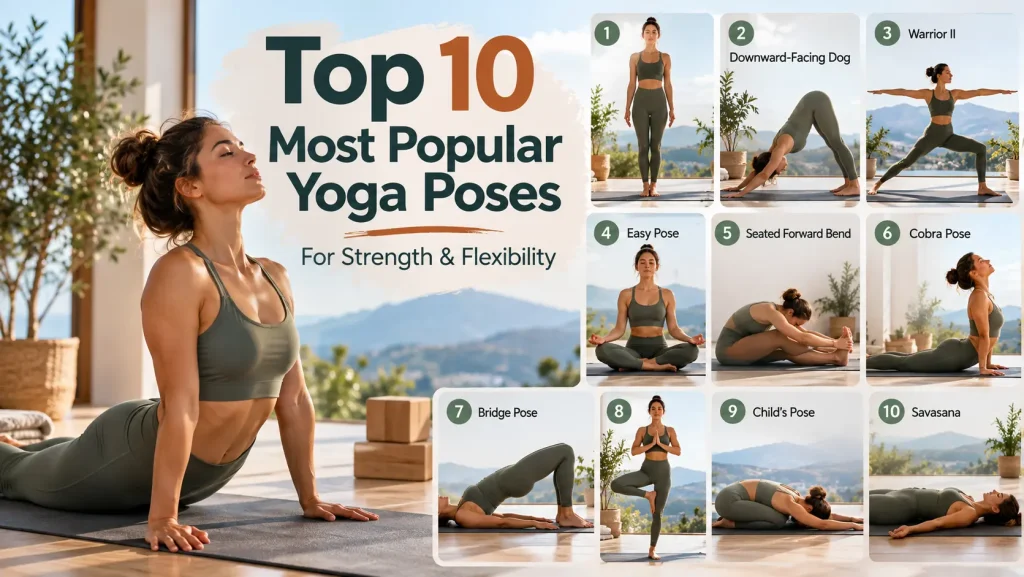
Below are 10 of the most familiar yoga poses, along with straightforward instructions and practical tips for making them work for you.
1. Mountain Pose (Tadasana)
Mountain Pose can look like you’re simply standing still, but there’s more happening than meets the eye.
It teaches you to pay attention to how you distribute your weight, position your body, and breathe while standing.
How to Do Mountain Pose
Stand comfortably with your feet together or slightly apart.
Spread your weight evenly across both feet rather than leaning forward or backward.
Lengthen upward through your spine while allowing your shoulders to remain relaxed.
Let your arms rest beside your body and look straight ahead.
Take 5–10 slow breaths.
Why Practice It?
Mountain Pose is useful for:
- body awareness
- posture
- balance
- learning standing alignment
- beginning or resetting between standing poses
Beginner tip: Don’t try to make your body rigid. Good posture doesn’t mean holding yourself as stiffly as possible.
2. Downward-Facing Dog (Adho Mukha Svanasana)
Few poses are more closely associated with modern yoga than Downward-Facing Dog.
It appears frequently in Vinyasa-style sequences and combines weight-bearing through the upper body with length through the back of the legs.
The original YogaMelt guide also identifies it as one of the site’s core popular poses and recommends bending the knees when the hamstrings feel tight. Pasted text
How to Do Downward-Facing Dog
Begin on your hands and knees.
Place your hands firmly on the mat, tuck your toes, and lift your knees.
Move your hips upward and backward.
Allow your head to remain between your upper arms without forcing your neck into position.
Hold for approximately 5 breaths.
Beginner Modification
Your heels do not need to touch the floor.
If your hamstrings feel tight, bend your knees. You can also alternate bending one knee and then the other.
That modification is often much more comfortable than forcing the legs straight.
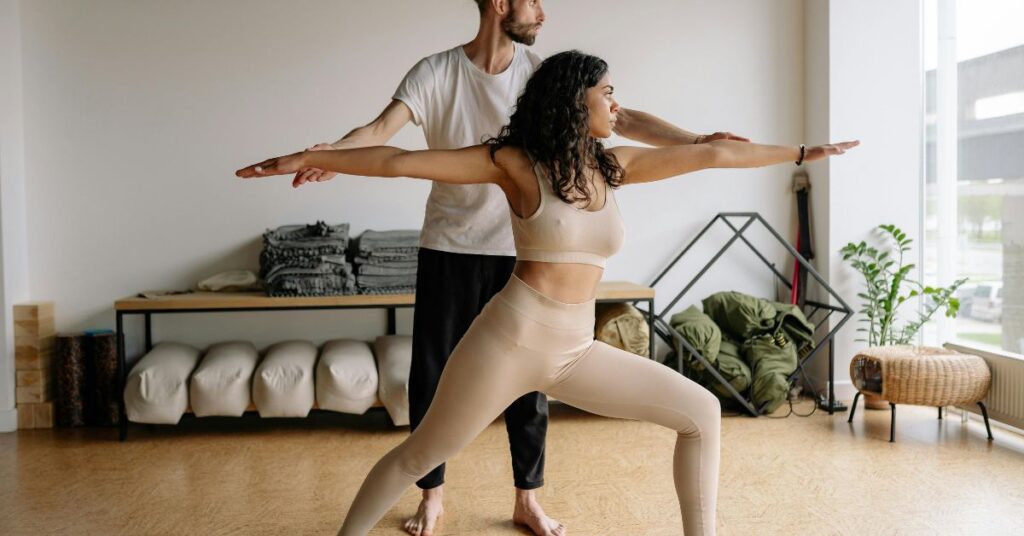
3. Warrior II (Virabhadrasana II)
Warrior II combines a wide stance with lower-body work, balance, and concentration.
How to Do Warrior II
Step your feet wide apart.
Turn your right foot toward the short end of the mat and angle your left foot slightly inward.
Bend your right knee while keeping it aligned in the direction of your toes.
Extend both arms horizontally.
Keep your torso tall and look toward your right hand.
Take approximately 5 breaths before repeating on the other side.
Why It’s So Popular
Warrior II can challenge:
- legs
- hips
- balance
- endurance
- concentration
Don’t worry about creating a perfect 90-degree bend in your front knee. Use a stance that feels stable and controlled.
4. Easy Pose (Sukhasana)
Easy Pose is another example of a yoga position that looks simpler than it can actually feel.
Sit cross-legged and you may immediately discover tightness around your hips or discomfort in your lower back.
How to Do Easy Pose
Sit in a comfortable cross-legged position.
Lengthen upward through your spine.
Rest your hands on your thighs or knees.
Relax your shoulders and breathe slowly.
Make It More Comfortable
If your knees sit considerably higher than your hips or your lower back rounds, sit on a folded blanket, cushion, or yoga block.
Elevating the hips can dramatically change how the position feels.
Easy Pose works particularly well for breathing exercises, meditation, or simply taking a quiet minute at the beginning or end of your practice.
5. Seated Forward Bend (Paschimottanasana)
Seated Forward Bend is a familiar hamstring-focused pose, but it’s also one that beginners frequently try to force.
There’s no prize for reaching your toes.
How to Do Seated Forward Bend
Sit with your legs extended comfortably in front of you.
Inhale and lengthen through your spine.
As you exhale, hinge forward from your hips.
Place your hands wherever they comfortably reach—your thighs, shins, feet, or a strap.
Stay for several breaths.
If Your Hamstrings Are Tight
Bend your knees.
This simple adjustment can make the pose considerably more accessible.
Focus on creating a comfortable stretch rather than trying to make your forehead touch your legs.
6. Cobra Pose (Bhujangasana)
Cobra is a prone backbend frequently used in beginner sequences and Sun Salutation variations.
How to Do Cobra Pose
Lie on your stomach.
Place your hands near your ribs or underneath your shoulders.
Keep your legs extended behind you.
As you inhale, gently lift your chest.
Keep your elbows bent rather than trying to push yourself as high as possible.
Allow your shoulders to move away from your ears.
Pause briefly and lower yourself with control.
Common Mistake
Don’t turn Cobra into an arm exercise by aggressively pushing against the floor.
A smaller, controlled backbend is perfectly valid.
7. Bridge Pose (Setu Bandhasana)
Bridge Pose moves you in a completely different direction from many seated and forward-folding postures.
It also adds a useful strengthening component to a yoga sequence.
How to Do Bridge Pose
Lie on your back.
Bend your knees and place your feet on the floor approximately hip-width apart.
Let your arms rest beside you.
Press through your feet and gradually lift your hips.
Keep your knees pointing forward rather than allowing them to fall outward.
Pause and then lower your spine and hips with control.
Repeat several times or remain in a comfortable hold for a few breaths.
What Does Bridge Pose Work?
Depending on how you practice it, Bridge involves the legs, hips, glutes, trunk, and upper body positioning.
You don’t need to lift your hips as high as possible to make the pose worthwhile.
8. Tree Pose (Vrksasana)
Tree Pose is one of yoga’s most recognizable balance positions.
It also demonstrates something important: balance doesn’t mean never wobbling.
How to Do Tree Pose
Begin standing.
Shift your weight onto your left foot.
Place your right foot against your left ankle or inner calf. If your mobility and balance allow it, you can bring the foot higher toward the inner thigh.
Avoid pressing the foot directly into the side of your knee.
Bring your hands together at your chest or keep one hand on a wall for support.
Look at one stationary point.
Take several breaths and switch sides.
Can’t Balance?
Use a wall.
Using support doesn’t make the pose less legitimate. It allows you to practice the position without making falling the main challenge.
9. Child’s Pose (Balasana)
Child’s Pose commonly appears as a resting position during yoga practice.
How to Do Child’s Pose
Begin on your knees.
Move your hips gently back toward your heels.
Fold your torso forward and bring your forehead toward the mat or a support.
Extend your arms forward or let them rest beside your body.
Breathe comfortably.
Make It Fit Your Body
If your forehead doesn’t comfortably reach the floor, place a block, folded blanket, or cushion underneath it.
You can also adjust the distance between your knees.
A resting pose should actually allow you to rest.
10. Corpse Pose (Savasana)
Savasana usually appears at the end of a yoga practice.
Physically, there’s very little to do—which can make it surprisingly challenging for people accustomed to constant movement.
How to Do Savasana
Lie comfortably on your back.
Allow your legs to relax.
Rest your arms beside your body with your hands comfortable.
Close your eyes if that feels appropriate.
Let your breathing happen naturally.
Stay for several minutes.
Rather than trying to achieve a particular result, simply allow yourself to be still.
The original YogaMelt article appropriately positioned both Child’s Pose and Savasana as relaxation poses at the end of the list. Pasted text
Which Yoga Pose Should Beginners Start With?
There’s no single mandatory first pose.
A beginner-friendly sequence could include:
- Mountain Pose
- Cat-Cow
- Downward-Facing Dog with bent knees
- Warrior II
- Tree Pose with wall support
- Bridge Pose
- Child’s Pose
- Savasana
You don’t need to master one pose before progressing to another.
Instead, learn a small collection of foundational positions and become more comfortable with them over time.
How Long Should You Hold a Yoga Pose?
It depends on the pose and the type of practice.
In a flowing practice, you might remain in a position for only one breath. During a slower session, you might stay for several breaths.
Rather than counting seconds obsessively, beginners can start with approximately 3–5 comfortable breaths in many poses.
Balance and strengthening positions may initially require shorter holds.
The important word is comfortable.
If your alignment begins deteriorating or you experience pain, there’s little value in remaining in the position simply because a timer hasn’t finished.
How Often Should Beginners Practice Yoga?
Consistency matters more than trying to complete a long session every day.
If you’re beginning, you might start with two or three sessions per week and see how your body responds.
Short sessions count too.
Ten or fifteen minutes gives you enough time to practice several foundational poses without needing to reorganize your entire day around yoga.
As the practice becomes familiar, you can adjust the frequency and duration according to your goals.
Common Mistakes With Popular Yoga Poses
Trying to Copy Someone Else’s Range of Motion
Bodies differ.
How deeply another person can fold, twist, or backbend isn’t a useful measurement of your own practice.
Thinking Modifications Mean You’re Doing It Wrong
Bent knees, blocks, straps, cushions, and wall support are tools.
Use them.
Holding Your Breath
If you’re concentrating so hard on the position that you stop breathing naturally, reduce the intensity.
Forcing Painful Positions
Yoga can involve muscular effort and stretching sensations, but sharp or escalating pain isn’t something to push through.
Come out of the pose and modify or skip it.
Chasing the “Perfect” Pose
There isn’t one universal visual standard that every body must reproduce.
Work toward controlled, comfortable movement instead.
FAQs About Popular Yoga Poses
What are the most popular yoga poses?
Some of the most recognizable poses include Downward-Facing Dog, Warrior II, Tree Pose, Cobra Pose, Bridge Pose, Child’s Pose, Mountain Pose and Savasana. These poses appear frequently across different yoga styles and levels.
What are the easiest yoga poses for beginners?
Mountain Pose, Easy Pose, Child’s Pose and Savasana are approachable starting points. Cat-Cow and a modified Downward-Facing Dog can also work well for beginners.
Do I need to be flexible to start yoga?
No. Flexibility isn’t an entry requirement for yoga.
Use modifications that allow you to practice comfortably at your current range of motion.
What yoga poses are good for flexibility?
Forward folds, Downward-Facing Dog and various hip-opening positions can all involve flexibility. Progress gradually rather than forcing greater range.
Which yoga poses help with balance?
Tree Pose is a classic starting point. Standing poses such as Warrior II also require balance and body awareness.
Can I practice yoga every day?
Some people enjoy daily yoga, but every session doesn’t need to be physically demanding. Frequency and intensity should reflect your experience, other activities, and how your body responds.
How long should a beginner yoga session be?
Even 10–20 minutes can make a useful beginner session. Starting with something manageable often makes consistency easier than immediately committing to long classes.
What should I do if a yoga pose hurts?
Come out of the position. Try a modification or skip the pose. Persistent, significant, or unexplained pain is better assessed appropriately than repeatedly stretched through.
Final Thoughts
The most popular yoga poses aren’t necessarily valuable because they’re famous.
They’re useful because many of them can be adapted across different practices and levels.
Start with the basics. Bend your knees when you need to. Use a wall for balance. Sit on a cushion. Rest when your body asks for it.
As your practice develops, these familiar poses won’t necessarily disappear.
You’ll simply understand them better.
That is one of the interesting things about yoga: sometimes the poses you encounter on day one are still teaching you something years later.
Sonu is a passionate yoga teacher with over 6+ years of experience helping individuals find balance, strength, and inner peace through the transformative power of yoga. As the creator of Pure Yoga Vibes, Sonu shares expert insights, inspiring practices, and a wealth of knowledge to support your wellness journey. Dedicated to creating a space for growth and mindfulness, Sonu’s mission is to make yoga accessible and enjoyable for everyone. For inquiries or collaborations, feel free to reach out at contact@pureyogavibes.com.