A long day on the trail can feel fantastic—until you stop walking.
Then you notice the calves that have been working uphill, the quads that controlled every downhill step, the hips that carried you mile after mile, and perhaps the shoulders that spent hours underneath a backpack.
Yoga can be a useful companion to hiking because it gives your body something hiking doesn’t: varied, deliberate movement.
You don’t need an hour-long class. A few carefully chosen poses before a hike can help you move through your joints, while a slower routine afterward can give tired areas some attention.
Here are 10 practical yoga poses for hikers and a simple routine you can use around your next hike.
Why Yoga Can Be Useful for Hikers
Hiking isn’t simply walking on a flat surface.
Trails ask you to step over rocks, climb inclines, control descents and repeatedly adjust your balance to uneven ground. Longer hikes can also mean hours carrying additional weight.
A complementary yoga practice can focus on:
- ankle and calf mobility
- hip mobility
- hamstring and quadriceps flexibility
- balance and single-leg control
- spinal movement
- shoulders and upper back
- relaxation after a long day outside
The goal isn’t extreme flexibility.
For hikers, comfortable movement, stability and body awareness are usually much more useful than trying to force yourself deeper into a stretch.
Yoga Before or After Hiking: Which Is Better?
Both can fit into your routine, but they shouldn’t look exactly the same.
Before your hike
Favor movement.
Use gentle, dynamic versions of poses instead of settling into your deepest stretch.
A few minutes of Cat-Cow, alternating Low Lunges, ankle movements and controlled balance work can be enough.
You’re preparing to move—not conducting a flexibility test.
After your hike
Slow things down.
Once your breathing has returned toward normal and you’ve had some water, you can spend more time in comfortable positions for your calves, thighs, hips and back.
On rest days
A longer gentle yoga practice can work well between hiking days, particularly during a multi-day trip.
10 Yoga Poses for Hikers
1. Mountain Pose
Mountain Pose looks simple, which is exactly why it’s useful.
Stand with your feet comfortably positioned and distribute your weight through them. Keep your knees relaxed rather than rigid.
Lengthen upward through your torso while allowing your shoulders to relax.
Take several slow breaths.
Then make the pose more relevant to hiking: slowly shift your weight forward, backward and from side to side without lifting your feet.
Notice how your feet respond.
That awareness becomes useful when the perfectly flat yoga mat is replaced by an uneven trail.
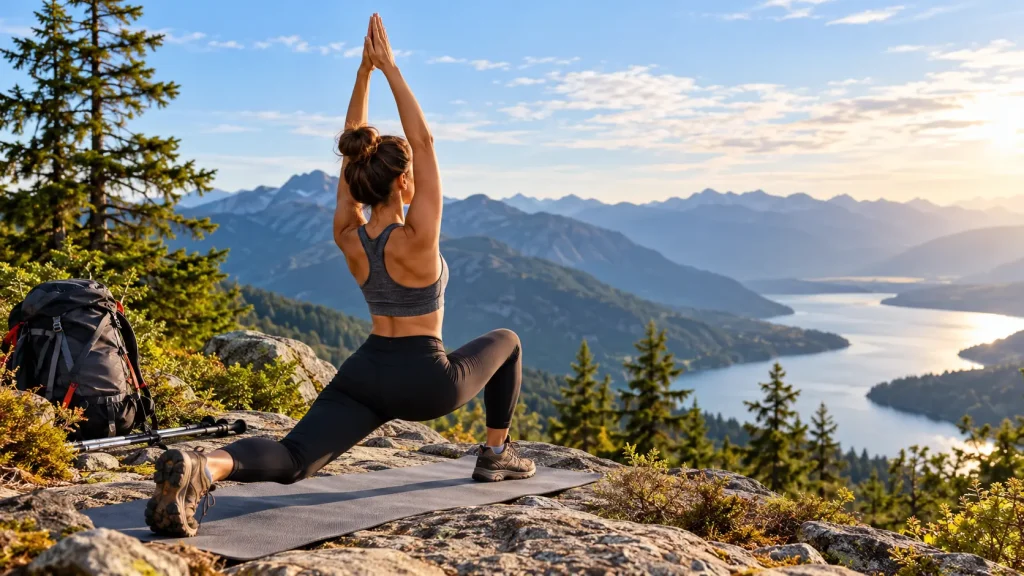
2. Low Lunge
Low Lunge is an excellent addition when you want to work around the hips and thighs.
Step one foot forward and lower your opposite knee to the mat. Keep the front knee comfortably positioned over the ankle and gradually allow your hips to move forward.
Avoid aggressively pushing into the deepest position.
Hold for several breaths and switch sides.
YogaMelt already has a complete guide to Low Lunge (Anjaneyasana), including technique, modifications and ways to incorporate it into a yoga flow. Yoga Melt
3. Downward-Facing Dog
Downward Dog can be particularly welcome after your calves and the backs of your legs have spent hours working on the trail.
Begin on your hands and knees, tuck your toes and lift your hips upward and backward.
Don’t make touching your heels to the floor the objective.
Instead, bend your right knee while gently lengthening through the left leg, then change sides. Continue slowly.
If both hamstrings feel tight, keep both knees bent.
4. Wide-Legged Forward Bend
Stand with your feet comfortably wide and hinge forward from your hips.
Place your hands on blocks if reaching the ground causes you to round excessively or strain.
Keep a small bend in your knees if necessary.
This gives your legs a position very different from the repetitive forward stepping of hiking.
YogaMelt’s detailed Wide-Legged Forward Bend guide explains the pose, modifications and variations in considerably more detail. Yoga Melt
5. Tree Pose
Balance matters on trails.
Tree Pose provides a simple way to practice standing on one leg in a controlled environment.
Shift your weight onto your left foot. Place your right foot against your left ankle or calf—or higher on the inner thigh if that’s comfortable—but avoid pressing directly against the knee joint.
Keep a wall or chair nearby if needed.
Focus your eyes on one stationary point and breathe normally.
Then switch legs.
Don’t worry if you wobble. The purpose is to respond to those small changes rather than to create a perfectly motionless pose.
6. Half Frog Pose
Your quadriceps can work particularly hard during descents.
Half Frog provides a front-of-thigh stretch that can fit nicely into a post-hike sequence.
Lie on your stomach and bend one knee, bringing the heel toward the same-side hip. Depending on your mobility, reach back toward the foot without aggressively pulling it.
YogaMelt has a dedicated Half Frog Pose guide with more detailed positioning and variations.
Use the pose gently after a demanding hiking day.
7. Cat-Cow
If you’ve spent hours walking with a backpack, some controlled spinal movement may feel welcome.
Begin on your hands and knees.
Inhale as you gently move your chest forward and allow your spine to extend.
Exhale as you round your back.
Move slowly between the two positions for approximately 5–10 breaths.
Cat-Cow is also easy to include in a warm-up before leaving home.
8. Bridge Pose
Hikers don’t have to spend the entire yoga session stretching.
Bridge adds controlled muscular work.
Lie on your back with your knees bent and feet on the floor.
Press through your feet and gradually lift your hips. Pause briefly before lowering with control.
Try 5–8 repetitions.
There’s no need to lift as high as possible. Prioritize smooth movement.
9. Reclined Figure Four
Lie on your back with both knees bent.
Cross your right ankle over your left thigh.
Stay there if you already feel enough sensation around the hip, or gently bring your left thigh toward your torso.
Keep your head and shoulders relaxed.
Stay for around 30 seconds before changing sides.
Never force the knee downward.
10. Legs Up the Wall
After you’ve spent the day going up and down a mountain, finishing with something simple can be appealing.
Lie on your back with your legs resting vertically against a wall.
Adjust your distance from the wall until you’re comfortable.
Then stop trying to accomplish anything.
Spend two to five minutes breathing normally.
Think of this as a comfortable relaxation position at the end of your practice rather than as a treatment for soreness or injury.
A 10-Minute Post-Hike Yoga Routine
You don’t need to remember all 10 poses.
After your next hike, try:
Cat-Cow — 1 minute
Move slowly with your breathing.
Low Lunge — 30 seconds each side
Keep the stretch comfortable.
Downward Dog — 1 minute
Alternate bending your knees if your calves feel tight.
Wide-Legged Forward Bend — 1 minute
Use blocks or another stable support when necessary.
Half Frog — 30 seconds each side
Don’t pull aggressively on your foot.
Reclined Figure Four — 30 seconds each side
Relax your upper body.
Bridge — 5 controlled repetitions
Move slowly rather than holding your breath.
Legs Up the Wall — 2–3 minutes
Finish quietly.
That’s enough for a useful post-hike routine.
A 5-Minute Yoga Warm-Up Before Hiking
Before hiking, make the routine more dynamic.
Try this sequence:
- Cat-Cow: 5–8 repetitions.
- Low Lunge: move gently in and out rather than holding deeply.
- Downward Dog: alternate bending each knee.
- Mountain Pose: shift your weight through different areas of your feet.
- Tree Pose: briefly balance on each leg.
- Easy bodyweight squats: finish by preparing your legs for the trail.
Keep everything comfortable.
You should feel ready to hike afterward, not as though you’ve already completed a workout.
Yoga After Uphill vs. Downhill Hiking
Different terrain can create different sensations.
After prolonged climbing, your calves and hips may be the areas you notice most.
After a hike involving substantial descents, your thighs may feel particularly worked because your legs repeatedly help control your body as you move downhill.
You don’t need a completely different yoga program for each situation.
Simply pay attention to what feels tired and adjust the emphasis.
For example, after a descent-heavy hike, you might spend slightly more time in a comfortable Half Frog or Low Lunge.
After lots of climbing, gentle Downward Dog may feel more relevant.
Your body provides better information than a rigid checklist.
Don’t Forget Your Upper Body
A common mistake is assuming hiking is only a leg activity.
A backpack changes that.
Your shoulders and upper back help manage the load, particularly during longer hikes.
After removing your pack, try:
- slow shoulder circles
- gentle Cat-Cow
- comfortable spinal rotation
- relaxed chest-opening movements
If neck and shoulder tension is a recurring issue, YogaMelt’s guide to yoga poses for the neck and shoulders provides additional options. Yoga Melt
Common Yoga Mistakes Hikers Should Avoid
Stretching aggressively because you’re sore
Feeling stiff after hiking doesn’t mean you need to force your body into its maximum range of motion.
Gentle movement is enough.
Ignoring balance
Flexibility receives a lot of attention in yoga, but hikers can also benefit from controlled balance practice.
Tree Pose is simple, scalable and easy to practice.
Doing a hard yoga workout after an exhausting hike
More isn’t automatically better.
After a demanding day, a few gentle poses followed by rest may make considerably more sense than another intense workout.
Stretching through pain
Normal muscular tension during a comfortable stretch isn’t the same as sharp, sudden or persistent pain.
Don’t try to solve unexplained pain by stretching harder.
Yoga for Multi-Day Hiking Trips
You don’t need to carry a yoga mat into the wilderness.
A campsite routine can be extremely simple.
Standing Low Lunges, gentle forward folds, shoulder movements and controlled balance exercises require little or no equipment.
Even five minutes can give you a chance to check how your body feels before the next day’s mileage.
If you practice outdoors, choose stable ground and don’t attempt challenging balance poses next to steep drops, water or unstable surfaces.
Yoga should make the trip more enjoyable—not add unnecessary risk.
Yoga for Hikers FAQ
Is yoga good for hikers?
Yoga can complement hiking by providing movement variety and opportunities to work on mobility, balance and body awareness.
Should I do yoga before a hike?
Yes, but keep the pre-hike practice relatively short and dynamic. Gentle lunges, Cat-Cow and balance movements are more appropriate than trying to achieve your deepest stretches immediately before walking.
Is yoga better before or after hiking?
Neither is universally better. Before hiking, use yoga as a movement-based warm-up. After hiking, use a slower practice for mobility and relaxation.
What yoga poses are good after a long hike?
Low Lunge, Downward Dog, Wide-Legged Forward Bend, Half Frog, Reclined Figure Four and Legs Up the Wall can all fit into a gentle post-hike routine.
Can yoga help hiking balance?
Balance poses such as Tree Pose provide a controlled environment for practicing single-leg stability and body awareness. Trail balance also depends on terrain, footwear, fatigue and other factors.
How long should I do yoga after hiking?
Ten minutes is plenty for a simple routine. There’s no requirement to complete a full class after every hike.
Should I do yoga if my knees hurt after hiking?
Don’t use yoga to push through significant, unexplained or worsening knee pain. Reduce movements that aggravate it and consider appropriate medical or physiotherapy assessment if the problem persists.
Final Thoughts
Hiking and yoga don’t need to compete for your time.
Hiking lets you cover ground, climb hills and spend time outdoors. Yoga can provide a few minutes of deliberate movement before or after that adventure.

Sonu is a passionate yoga teacher with over 6+ years of experience helping individuals find balance, strength, and inner peace through the transformative power of yoga. As the creator of Pure Yoga Vibes, Sonu shares expert insights, inspiring practices, and a wealth of knowledge to support your wellness journey. Dedicated to creating a space for growth and mindfulness, Sonu’s mission is to make yoga accessible and enjoyable for everyone. For inquiries or collaborations, feel free to reach out at contact@pureyogavibes.com.